

TOW YOUR BOAT
By Roy Sparks
Boat U.S. reports that over three-quarters of its calls for help on the road are for trailer breakdowns, while the rest of calls are related to problems with tow vehicles. To get you the confidence you need to tow your pontoon or deck boat safely, here are 10 tips to get you started.
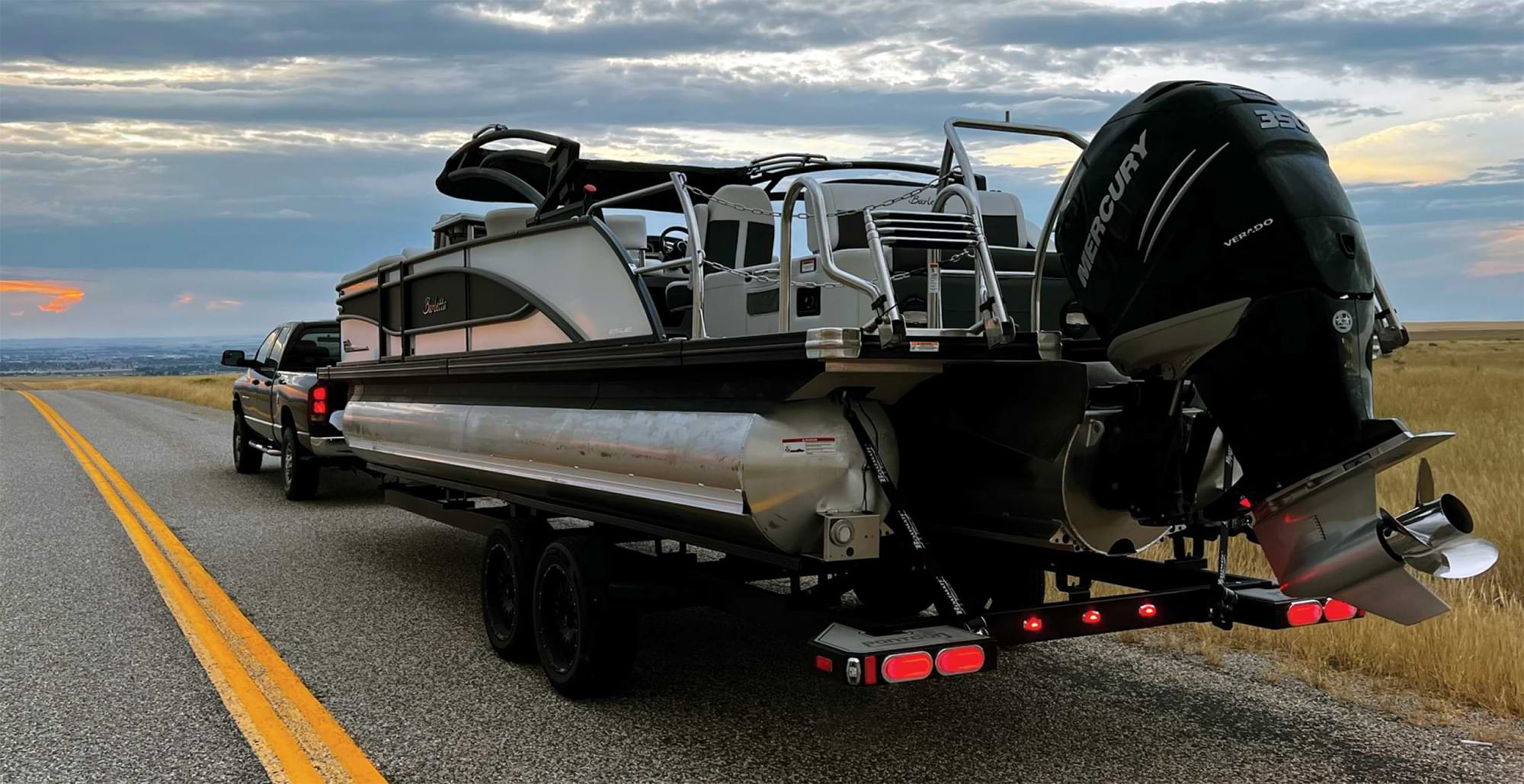
Before you set off, it’s important to always distribute the weight of your boat evenly, both side to side and front to back. That means arranging objects sitting on board the boat so that they’re not all crammed in one place. Such objects can include water skis, wakeboards, ropes, anchors, and other equipment. It’s generally best to limit heavy cargo to your towing vehicle, but if you must store heavy objects in your boat, always disperse them evenly on board to reduce the chance of the boat pulling off. DO NOT store various objects in one specific location on the boat to add weight to or remove weight from the trailer tongue. Objects can and will shift around to different parts of the boat’s storage areas when accelerating and decelerating, significantly altering the integrity of the trailer.
When driving, the most important measure to take is to allow more stopping distance, as the boat on the trailer almost doubles the weight of the entire entity. Avoid sudden starts, stops, or turns that can throw off trailer stability, and always engage a low gear when driving downhill. Such movements can also throw the boat off and cause a serious accident if accelerating or decelerating quickly enough.
While on your way, a good rule of thumb is to check the trailer after one, 10, and 100 miles in case a strap comes loose. It’s also important to carry a spare tire compatible with your trailer, a jack and jack stands, wheel chocks, a lug wrench compatible with the wheels, and a tire gauge. However, keep your mind off of it as much as possible when behind the wheel. Proper upkeep of your trailer is sure to help reduce driver stress.
We can now understand why preparing to safely trailer your boat on a long road trip is an involved process. Trailers have complex mechanisms (especially in the wheels and axles) that are all interconnected. When one component fails, damage to the trailer or hitch can prove costly. That’s why just because your vehicle is powerful enough to tow the boat doesn’t necessarily mean that it’s “ready.”
Especially before the beginning of a boating season, it’s important to inspect trailer mechanisms, because the trailer has been sitting in storage for a long time. Not all of these checks should be performed before every single trip, but you as a boater should still be mindful throughout the season. What absolutely must be done before every trip, though, is balancing the boat’s weight and inspecting important safety devices, including the winch, straps, and lights. This is not a process to be taken lightly, because you don’t want to be spending vacation time broken down on the side of the road.