


Putting the throttle down on the 600hp VREX
By Brady L. Kay
It’s an overcast day on the Atibainha River with not another boat in sight. We have the water all to ourselves and I’m excited to be on the latest VREX pontoon from VCAT Boats. I’ve been on plenty of twin-engine pontoons during my 25-year career in the industry, but I’ve been promised that the dual 300hp outboards from Suzuki on this performance model will surprise me. I like those kinds of surprises, so that’s why I’m here.
I get behind the wheel and as we’re slowly creeping away from the loading docks on this unfamiliar body of water, I scan the horizon in an attempt to locate a sign or really anything posted that might indicate we’re still in a no wake zone. Fighting a language barrier, I turn to VCAT’s engine specialists Wagner Nobre to see if we’re clear to go by giving him a hesitant thumbs up. He prefers to go by Waguinho, and he smiles and makes the motion for me to hammer down the throttle since he doesn’t speak much English. I’m in Brazil and my Portuguese is limited to very basic greeting phrases, yet it’s clear Waguinho, with a big grin on his face in anticipation, is ready for me to send it.
Usually when I’m on a boat for the first time, I like to ramp up the speed gradually. Blame it on the jet lag, but on this day I get caught up in the excitement and hammer the throttle down without any hesitation. As I do, I’m instantly pinned back in my helm chair as if I were shot out of a cannon. Surprised?! Oh yeah, you better believe I am.
The bow stands up like a 1970s Dodge Challenger doing a wheelie in a street drag. I’m sure there are other vintage muscle cars this VREX could be compared to, but there aren’t many twin-engine pontoons I could compare it to.
I let off the throttle and turn to Waguinho and he’s still smiling as he looks at my shocked face. It doesn’t matter that I don’t speak his language; he knows what I am thinking. I can easily understand why he is so excited for me to run the VREX, and I also know that at this moment, it is going to be a great day on the water.


There is no question that this VREX is built for performance. We’re talking zero to 60 miles per hour in less than 4 seconds kind of fast. On the open water, we easily reach a top speed in the mid-60s, but this is more than just raw power: it is naval engineering at its best.
As for the “secret sauce,” it all starts with the trimaran hull. By distributing volume among three floats, the boat gains stability, reduces draft, and increases buoyancy.
The cylindrical shape of the floats provides a favorable ratio between volume and water resistance, reducing the contact area and, therefore, friction.
While a traditional monohull “pushes” water to move forward, the trimaran glides over it — with much less effort. Of course, it doesn’t hurt having this pontoon performance hull paired with twin Suzuki outboards. It’s always more fun when you have 600hp to play with.
Another key to the performance is that the floats are finned, a refinement that further elevates them on the surface. The proven design transforms the VREX into a machine of extremely high planing efficiency and energy.
And combined with the lightness of marine aluminum — it can be up to 40 percent lighter than fiberglass structures — the result is pure performance with control and power.
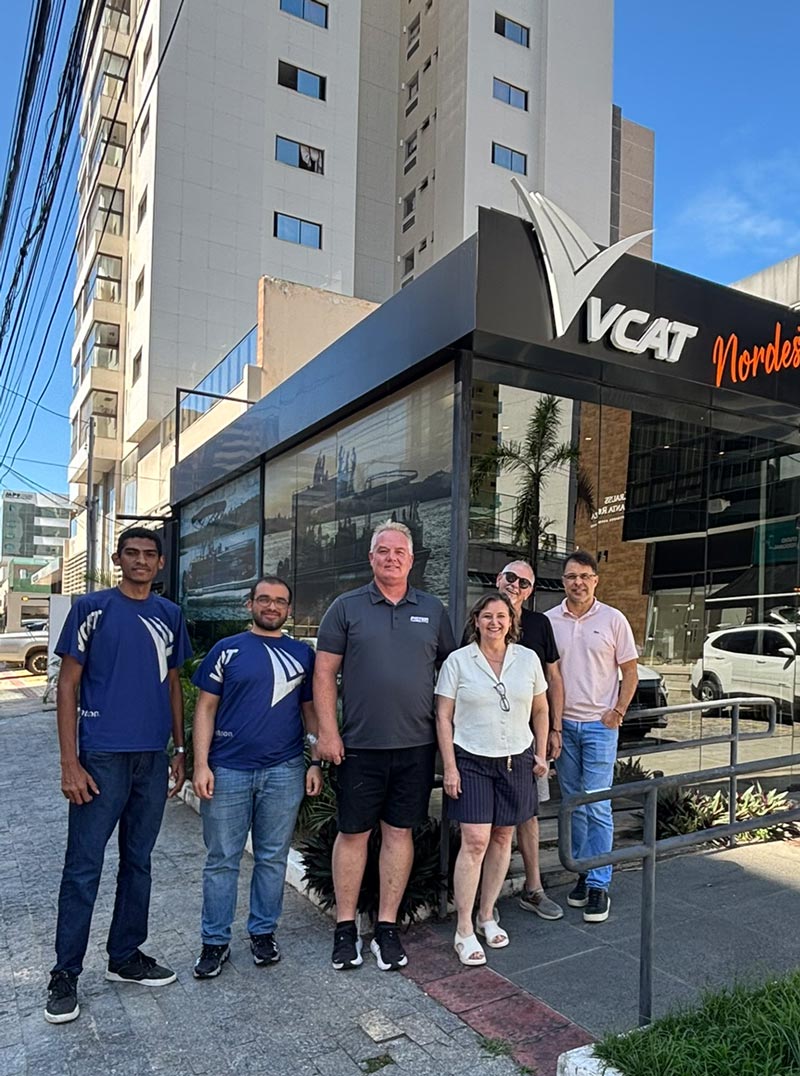

Brazilian natives Benedito Prado Neto, his wife Valéria De Fusco Pereira and their business partner Marcos Ferreira, invited me to their country to see the impressive VCAT facility and their luxury day-use pontoon boats. On my return trip to this beautiful country last fall, the follow-up trip proved to be just as educational. I was reminded once again that high-quality pontoon boats are not limited to just North America.
The popularity of our favorite craft continues to expand globally because of manufacturers such as VCAT Boats. As true pioneers, you could trace VCAT’s roots and recognize them as the first to introduce pontoons to their home country of Brazil. Founded in 2010, VCAT was born to bring the concept of American pontoon boats to Brazil, launching the first model in 2012 after two years of research and prototyping.
“VCAT was born from a dream of wanting to do something new,” explains Valéria. “We wanted to produce something new to the boat market here that also made sense for our lifestyle.”
Before beginning, the manufacturer had three specific requirements: to use recyclable raw materials, reduce production waste, and provide a particular design for the Brazilian market.


“When you bring a new concept, you are responsible for setting the standards of the market,” says Neto.
It’s one thing to have a dream, but another to turn it into reality. Everything was new, and a considerable investment in heavy machinery was needed to bend, weld, and perform other manufacturing tasks.
Because the concept of pontoon boats was so new to the country, the owners had to build some of the manufacturing equipment needed to start building their VCAT boats themselves. Its “build it yourself” mentality still rings true today with 95 percent of its production internalized—from 3D printing of parts and welding of floats to upholstery and carpentry—and proprietary software such as VCAT Avatar. By combining state-of-the-art machinery with artisanal detailing, VCAT delivers durable, low-maintenance projects while remaining environmentally responsible.
With more than 1,000 vessels delivered to date, and exports to three countries, VCAT is proud to operate on 100 percent solar energy and to incorporate more than 24 tons of recycled aluminum and 3 tons of reused plastic into production.
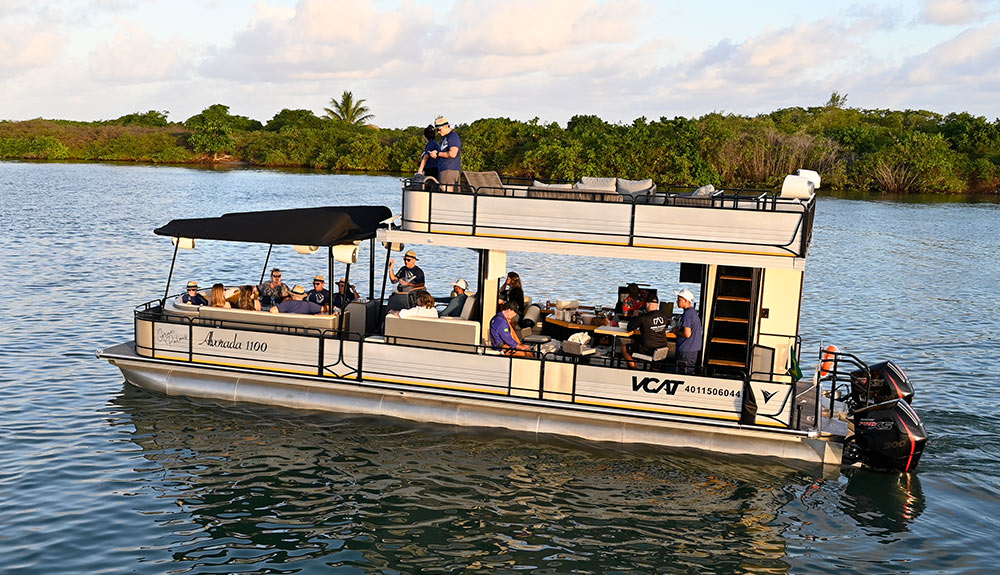

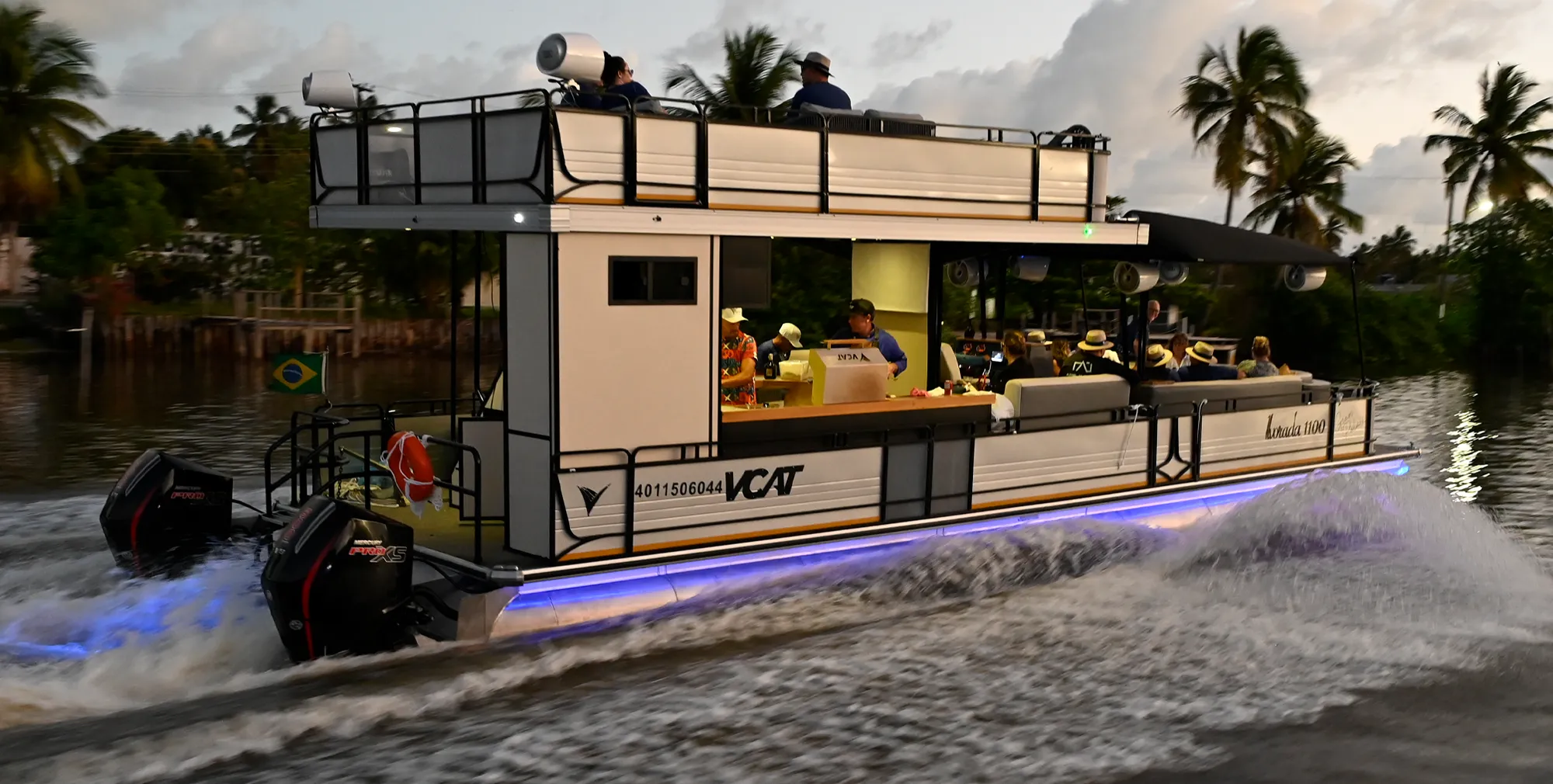
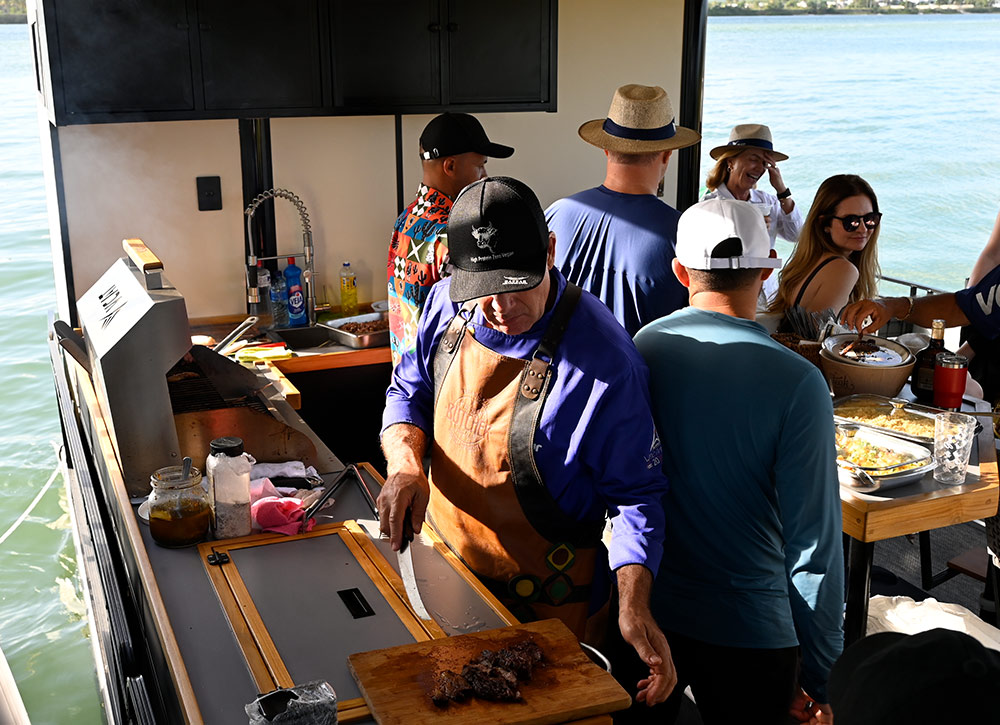
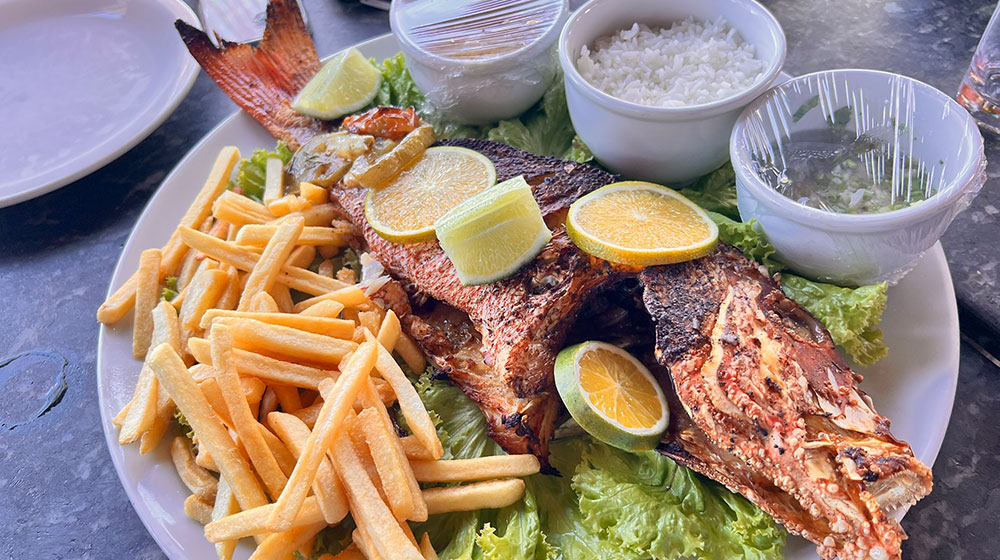
Neto and his wife, Valéria, truly know how to throw a boat party, and it starts with hiring a chef with his own staff. Steak, chicken, fish–it felt like every 20 minutes or so, a new dish was served while popular Latin music played in the background. Another Alvorada 1100 joined in on the fun when one of their customers came along for the day. Having a second boat full of additional guests wasn’t an issue for the chef; he had enough food and beverage to keep everyone on both the 36-foot boats well-served.
VCAT may have started from scratch with only a dream, but they have clearly brought high-end pontoon boats to Brazil and the surrounding countries. Decades from now, we’ll be able to see how their pioneering efforts have made a gigantic contribution to the boating industry and truly measure their reach in the pontoon industry.


For More Information
www.vcat.com.br