


Tackle Box logo
Catch It Live!
By Dan Armitage
Catch It LIVE!
By Dan Armitage
Live bait such as minnows, worms, insects and crustaceans offer most anglers – beginners and veterans – the best chance at hooking-up to the gamefish they seek. Think about it: why should a fish be fooled into trying to eat something made of plastic, metal or wood, no matter how realistic, when they could have the real thing? Many, many times I have been skunked when using artificial lures only to have fish attack a hook embedded in a live minnow or worm offered in the same spot. Sure, there are times when fake baits will do a great job at fooling and catching fish, and I use them often. But all things being equal, I can’t picture a scenario where the fish would pass up the real deal to strike artificial food.

What’s more, collecting your own live bait can be as much fun as fishing with it, and is a great way to get and keep kids involved in the activity while saving some coin in the process.

Catching Minnows
Let’s consider minnows and other popular baitfish. The easiest way to get fresh minnows – other than buying them at the local bait shop – is to catch them in a trap made for the purpose. Minnow traps are constructed of nylon or wire mesh and are rectangular or cylindrical in shape with inverted funnel-shaped openings to make it easy for the fish to enter, but once inside make it tough to relocate that entry point to use as an exit. To set these traps, you place some bait inside, drop the trap into the water, and tie it off to the dock or shore. If you’re in a productive area and use an enticing bait (a can of cat food punched with multiple holes makes a good attractant; so do tightly squeezed bread balls), you may see minnows arriving almost immediately; otherwise, leave the trap out for a few hours or overnight and you can expect to have fresh bait flipping around the mesh when you check it.

A more aggressive approach to minnow collecting, and for those who need minnows sooner rather than later, involves using nets and, more often than not, getting wet in the process. There are any number of nets made for catching minnows, and the most popular among inland and coastal fishermen alike is called a cast net. A cast net is a round hoop of fine mesh, anywhere from four to 15 feet or more in diameter, edged with weights and tethered to the angler’s wrist with a long central line. The net is thrown – or “cast” – to open up and drop over areas where minnows are concentrated and can be used from boats, docks or shore. After it sinks, the net is drawn tight around the catch by a line pulled through the center of the mesh circle, trapping the contents. Cast nets take some practice before you can expect to throw them so the netting opens properly on a consistent basis, and the smaller the diameter the easier to learn. Once you get the knack of throwing one you’ll enjoy catching the bait almost as much as reeling in the fish they catch.

Umbrella nets are another fun and effective way to collect live minnows, crabs and crawdad. They are especially good to use in clear, shallow water where you can watch the bait gather atop the mesh before you lift the net up and out of the water. You can fish umbrella nets “blind” in deep or murky water, and for suspended fish as well. Similar to an inverted umbrella, the mesh net is round or square in shape, from 3 to 6 feet in diameter, and held taut and open with wire supports. Each corner has a line that is connected to a single main cord, that is used to quickly lift the net to capture baitfish that are swimming over it. I like to place the net on the shallow bottom next to a dock and sink bread balls over it to attract minnows. Once I see baitfish feeding over the center of the mesh, I lift it and add the contents to my bait bucket.

Catching Crayfish & Other Critters
Crayfish hide under rocks during the daylight hours and venture out to feed at night. If you’re quick and willing to get wet, you can catch “crawdads” by hand one at a time by lifting rocks and grabbing the crustaceans around the body just behind the pinchers. As long as you target the smaller ones, the errant pinch you’re sure to get when you hold them in the wrong place won’t hurt too much.

Crayfish also can be caught in minnow traps or traps designed for catching them, which are set right on the bottom and left overnight.

But on a hot summer day, the most active and enjoyable way to net a few crawdads, as well as hellgrammites and minnows, is to use a seine net. A rectangle of mesh with weights along the bottom, floats across the top, and poles of wood, fiberglass or metal along each end, seines are used in current and count on the flow to wash bait into the netting and hold it there until the netter can grab it.
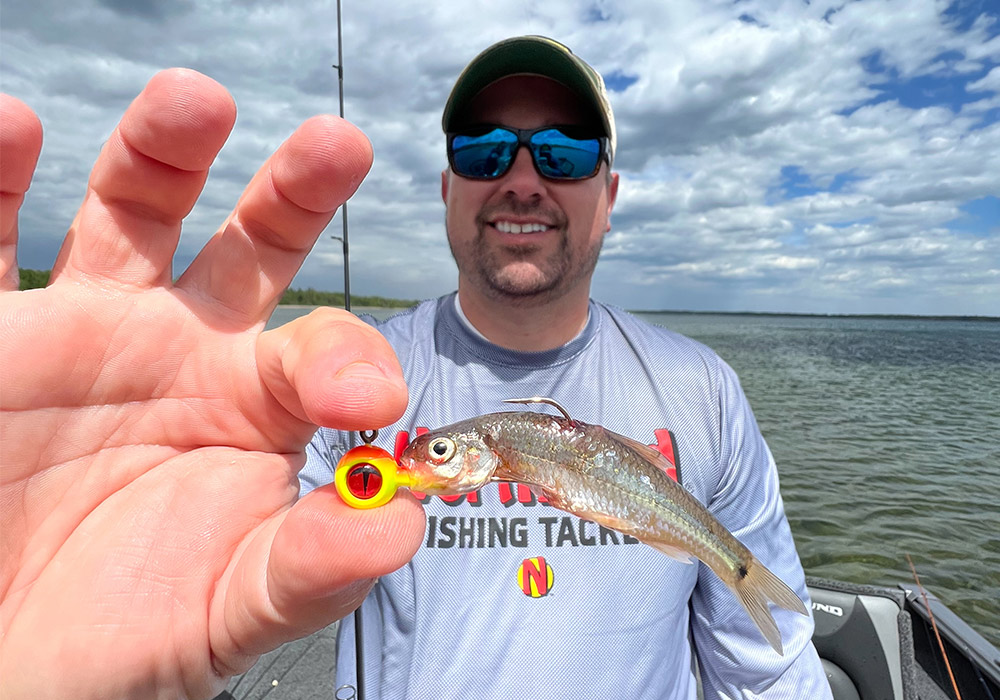
A close-up shot shows a man holding a small fish that has been caught on a fishing lure.
Catching your own bait, such as live minnows, can be as much fun as the fishing.
Several mesh-covered cages of varying shapes and sizes are arranged on a patch of green grass in an outdoor setting.
Traps made for catching minnows and crayfish are easy to use and very effective.
The most productive bait-catching method when using a seine calls for holding it in the current with the lower edge of the net close to the bottom and the top edge near or above the surface. A lone netter can walk upstream with a narrow, one-person seine suspended across the current and hope to catch critters that swim past or try to flee and get caught against the mesh, but having a buddy or two to help makes seining more fun and effective, when using a one-person or a broader seine, that may stretch ten feet wide or more. With someone walking directly upstream of the net and turning over rocks, kicking up the gravel and generally disturbing the bottom, you’ll rout out the finned and clawed residents – any of which should make a great bait.
Catching ‘Hoppers & Crickets
Crickets and grasshoppers make a great summer bait, when fish are familiar with feeding on the insects that hop, drop or get blown into the water. You can catch grasshoppers all day long with a butterfly net, prowling fields where you see them winging away from your approach and then spotting where they land. Crickets can be caught at night with an old wool blanket sprayed with sugar water or sprinkled with cracker crumbs and left in a grassy field overnight. The crickets come for food and shelter and their legs get ensnared in the blanket’s fibers.

You can also use whole loaf bread to catch crickets; cut the loaf in two and dig out the soft, doughy contents, leaving two shells of mostly crust. Cut a thumb-sized hole in each end and put the two halves back together loaf-like, securing them in place with a large rubber band. Leave the loaf trap overnight in a field or area known to harbor crickets and by morning the inside should contain several prime summer fishing baits.

DIY Worms
Get digging. Any garden will hold worms, as will logs and rocks that you can turn over to reveal some of the best baits available at any price. Better yet, water the lawn at dusk then head out with a flashlight and a light step. Worms will be drawn to the surface by the water and you can pick them up, much like after a spring rain shower when the sidewalks teem with worms. You can also add dry mustard to water sprinkled on a grassy surface or garden loam to prompt an eruption of nightcrawlers. Or, try your hand at grunting them up with a wooden stake driven into the ground and rubbed with a board or ax head to create vibrations that push the bait to the surface. Google it!

Note that catching your own live bait can be addictive; don’t be surprised if you spend so much time – and have so much fun – collecting critters that you forget to go fishing.

For More Information
Frabill offers minnow traps, crawfish traps, umbrella nets, seines and a variety of bait containers to hold your catch. For more information, call Frabill at 800-558-1005 or visit them at www.frabill.com.
Dan’s Pick
Cape Fear Harpoon boat floating on water with a man and woman on it
CAPE FEAR HARPOON
Yes, I understand that this may not identify as a pontoon boat, but it’s close enough that I had to look into the new model from Cape Fear. That and the fact that this is one of the slickest-looking craft I have seen in some time. I’ll let the photos speak for themselves, but the specifics include all-welded marine aluminum construction in a variety of custom colors, foam-filled hulls, custom Dek-it underfoot, beach chair storage with cooler, fully appointed, shaded helm with four rod holders, seating for six, hidden swim ladder and a trampoline that simply looks fun to hang out (fish?) on.

With a pair of 50hp outboards standard, the boat is quick with speeds approaching 40 mph, and with the broad stance is extremely stable at speed, while angling or hanging out on the trampoline considering your next move. No, it’s not a traditional pontoon, but the Harpoon offers many of the attributes that make them such popular watercraft. And this one’s sure to turn some heads!
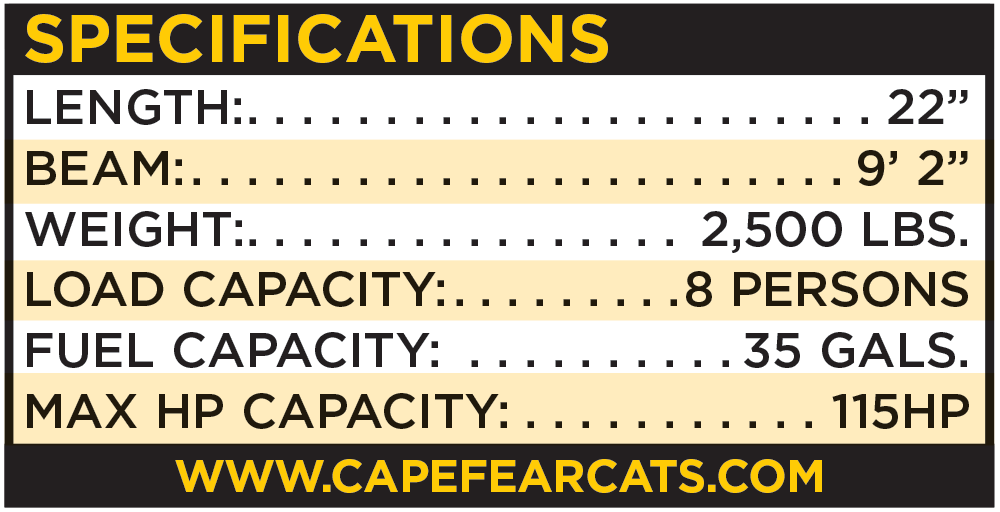
Cape Fear Harpoon specifications table