


These days, hot fishing for big channel cats is in range of just about any interested angler. Their abundance and potential size are just two among many reasons for the popularity of the bottom feeders. Another reason for attempting a late-summer catfish adventure: there are as many ways to catch them as there are cupholders on your current deck or pontoon boat.
One of the region’s most successful catfish fishing guides, Brad Durick works the waters of the Red River, which is famous for its huge channel cats and rather bizarre 550-mile south-to-north flow. Originating at the confluence of the Bois de Sioux and Otter Tail rivers between Minnesota and North Dakota, the Red River flows northward through the Red River Valley, forming most of the border between the two states and continuing into Manitoba, where it empties into Lake Winnipeg.

By mid-summer, water flows have stabilized and catfish have fully finished spawning and movement patterns become predictable. While most anglers during this time continue focusing on obvious fishing spots, such as visible wood snags, rockpiles, deep holes or dams, Durick has a quiver of prime catfish spots to himself.
“Everything I do relates to current,” says the Coast Guard licensed captain. “The best thing catfish anglers can do for themselves is learn to read the water. Every key change in the river bottom is revealed by things happening on the surface.
“Catfish flock to current seams—where two currents come together. On the surface, it’s often a subtle sign. But once you know what it looks like, seams are as obvious as a downed oak tree. Current breaks and their underlying topography are incredibly overlooked, but they have everything a catfish needs—a break from current, oxygen, and of course food.”
Durick says that while a big gnarly woodpile might look great, if it lies out of the main flow, anglers will struggle to catch catfish there. Conversely, even a small bush or a subtle hole can gather multiple whopper catfish—if it’s associated with substantial current. One of Durick’s better midsummer spots is a 4- to 10-foot trench cut into the outside of a river bend. His best troughs are often the shallowest ones.
“I really like 3- to 4-foot holes with a trough-like effect. Food is dropping into these spots all the time. And even though there might be strong current flowing into it, there are always areas of reduced water flow where cats can hold and wait for food.”
Associated overlooked summer spots, Durick says, are small holes near a shoreline break, especially those with current seams running along their edges. In higher water years, he’s also had great fishing below dams all through summer.
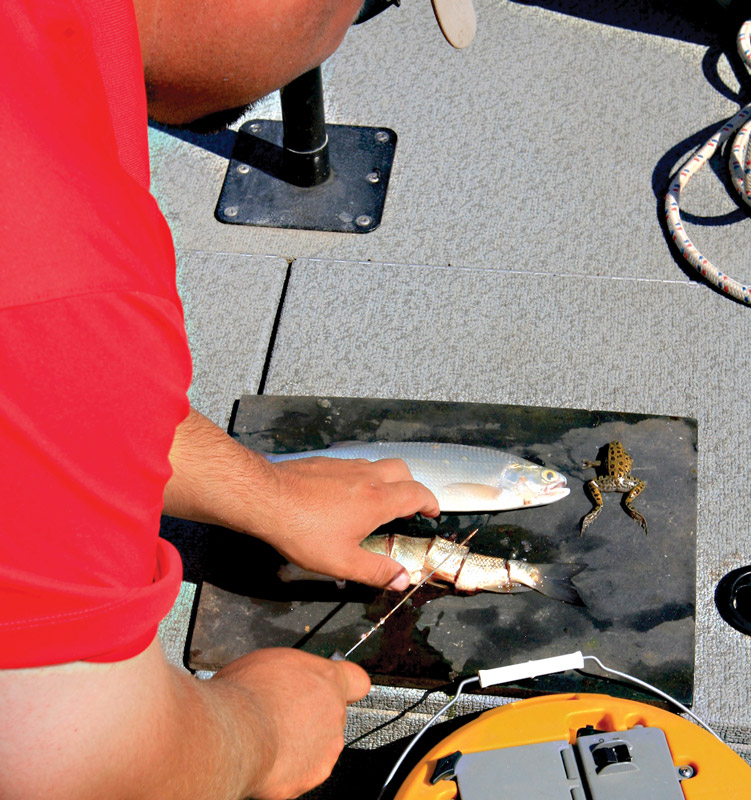
“Most of the time, I use suckers cut into small ‘steaks,’” offers Durick. “They’re abundant, inexpensive and catfish gobble ‘em up.” When available, Durick also uses wild goldeye, fresh from the river. In wetter years, particularly during August and September, leopard frogs emerge en masse. The late summer frog bite can be exceptional, but prevailing dry weather sometimes eliminates this amphibious pattern.
Durick adds another observation about extra warm water. “In the hottest summer weather, for whatever reason, catfish often prefer to bite frozen bait over fresh cut specimens. I think maybe warmer water pulls the blood and oils out of fresh bait faster than frozen stuff. Regardless, I’ve found that marinating or dowsing my cutbaits in an attractant called Scent Trail has significantly increased my bites. It’s powerful stuff.”
In most spots, Durick employs a special 20-pound Cat River Anchor, which he says holds in any type of bottom. That said, he rarely sits in a single spot for more than 15 minutes, unless he’s fishing after a front, or after a drop in water temperature, which slows catfish activity. Which is all the more reason to anchor-up, bait up, and relax for the long haul – one of the perks of summer catfishing wherever you wet a line.

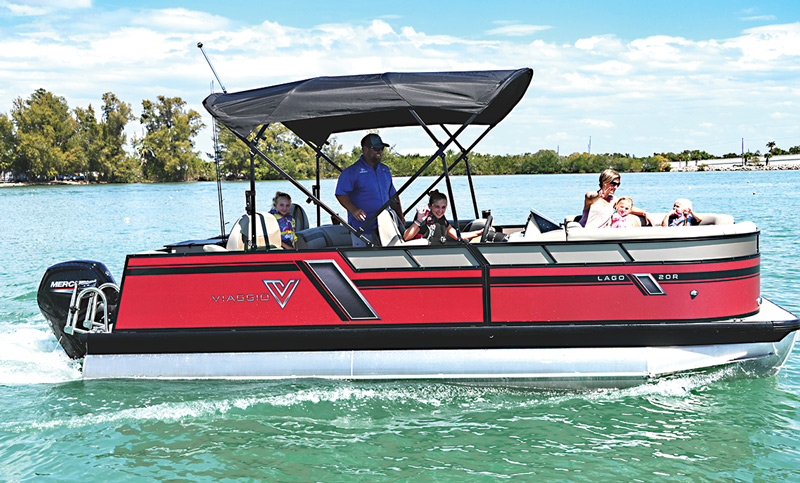
The boat has a tremendous amount of dry storage space under every bench seat for any gear you may bring with you on the water. Those seats are constructed using a high-end acrylic-coated vinyl with anti-mold and mildew, and anti-pinking resistance, which is comfortable and easy to clean. Underfoot is luxury woven vinyl flooring that is comfortable on your feet, also extremely easy to clean, and appears to be very durable.
Options of interest to anglers aboard the 20-footer include a wash down station, dual battery switch, digital depth finder, Simrad Go7 chartplotter, Lowrance Hook 2-4 or Hook 2-5 HDI, and underdeck and aft underwater fishing lights. However you custom rig it, the 20R is a practical fishing and cruising platform that looks great and is priced right.
- LENGTH:21′ 2″
- BEAM:8′ 6″
- WEIGHT:1,945 LBS.
- WEIGHT CAPACITY:2,130 LBS.
- FUEL CAPACITY:26 GALS.
- MAX HP:115HP