

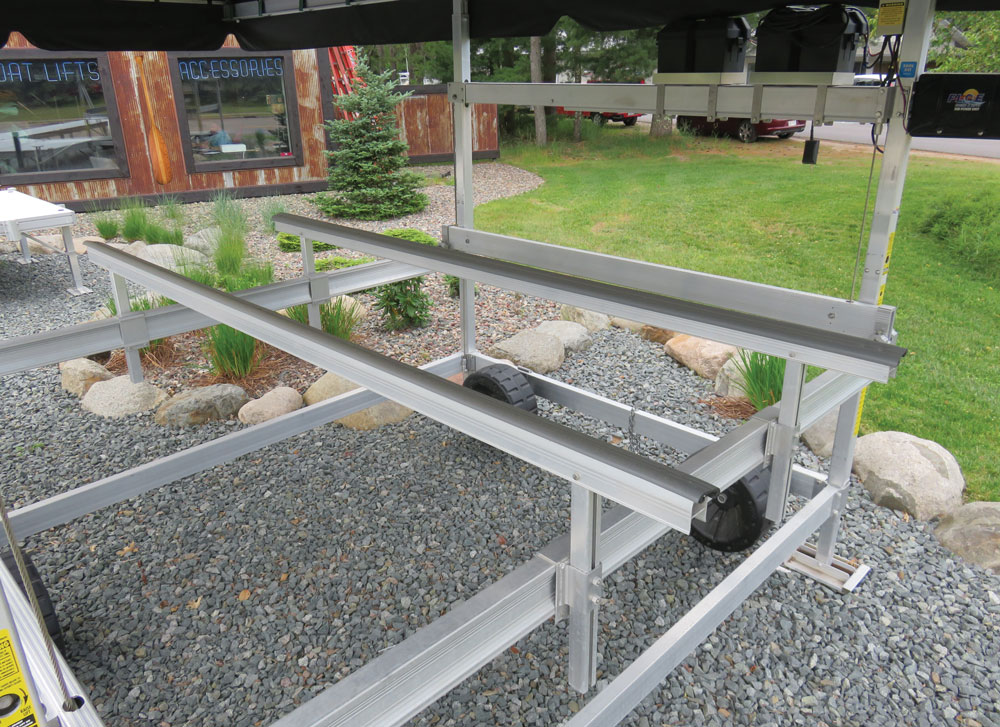
It just happens that our local lift dealer, Lakeside Dock & Lift, sells the FLOE brand. We already had a FLOE pier, so our first stop was back to the same dealership. There’s a good selection of quality boat lifts on the market today. Proximity to the nearest dealer is what usually guides most purchases.
I’ve been in the marine industry for more than four decades. While we’ve witnessed some of the most groundbreaking evolution in boat and propulsion designs, I figured a boat lift would be a pretty simple purchase. A lift goes up and down; pretty simple, right? Pick the canopy cover color, and we’re done, right? Well, yes, but… there’s always a “but” to it. Yes, old dogs can learn new tricks, and we needed to.
I know the length, width, and weight of our two-logged pontoon. That’s a good start, but just like when buying a boat, car, or other assets, the lift salesman went through a thorough list of questions before recommending the right one for us. I’m sure other salespeople will start their questions differently, but I thought it was interesting that the questions about the boat weren’t at the top of Andy’s list.
- Will it sit on a sandy or mucky bottom? (Ours is a mucky bottom.)
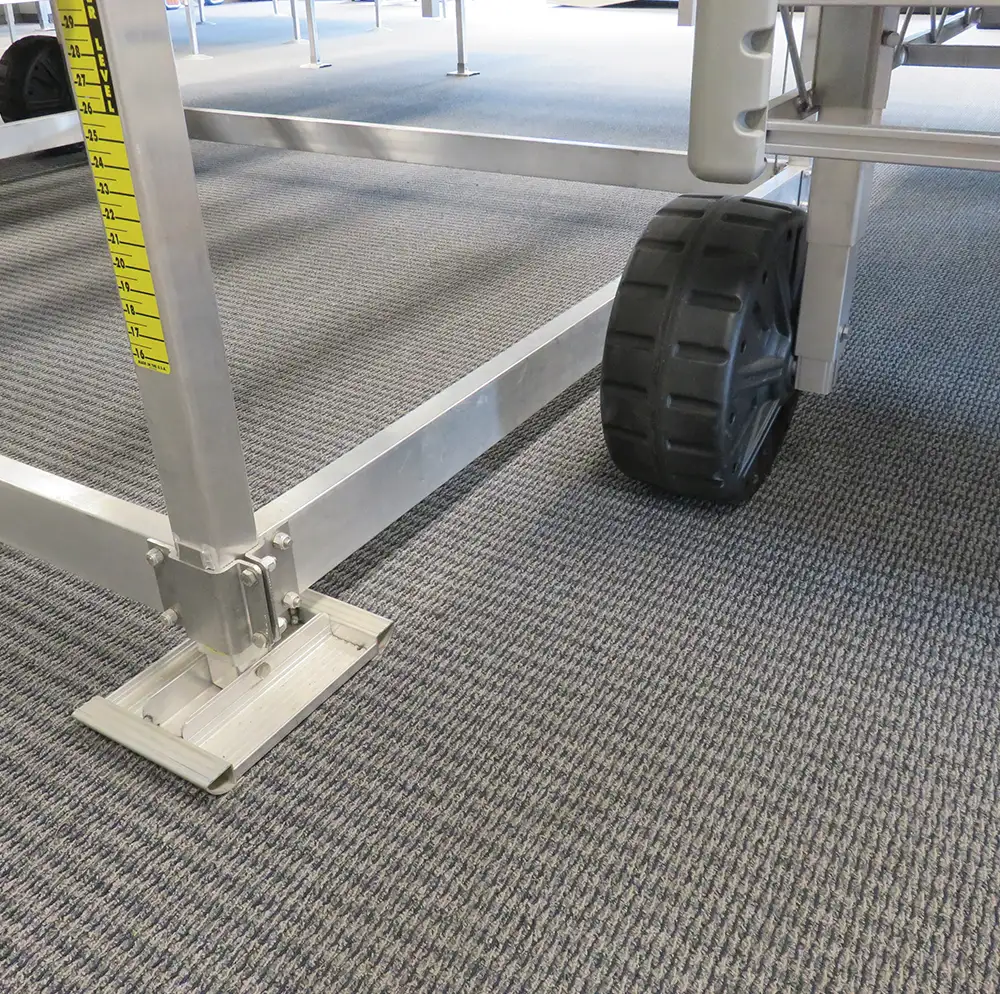
- Will it be able to launch on its own wheels, or will it need to be set in place on pads at the bottom of the lift legs?
- How deep is the water where the lift will stay?
- Many lifts need at least 26 to 30 inches of water to float your boat off the bunks.
- Will the lift need leg extensions for deeper locations?
- If it needs to be set in place by a service, is there lake access for them?
- Do you have an installer, or will the dealer need to handle installation and seasonal removal?
- Are there restrictions for launch times at a public access ramp?
- Is the site at a private lot or rental?
- Where will you store the lift in the off-season?
- Near the shore where it will be used or at another location?
- Is it a conventional two-log pontoon or triple-log pontoon?
- What is the length, width, and weight of the boat? (We have a classic, 18-foot pontoon with a 25hp four-stroke outboard. It has a manual Bimini and last winter I added six cupholders. If we need to tow the grandkids around, we launch the ski boat.)
- What powers the boat?
- Single outboard, twins, or a stern drive?
- Is there an arch, is it fixed or a retractable Bimini top?
- Does the arch have any mounts or racks?
- An arch may require a higher canopy frame.
- Are there any items that extend outside the fences on either side?
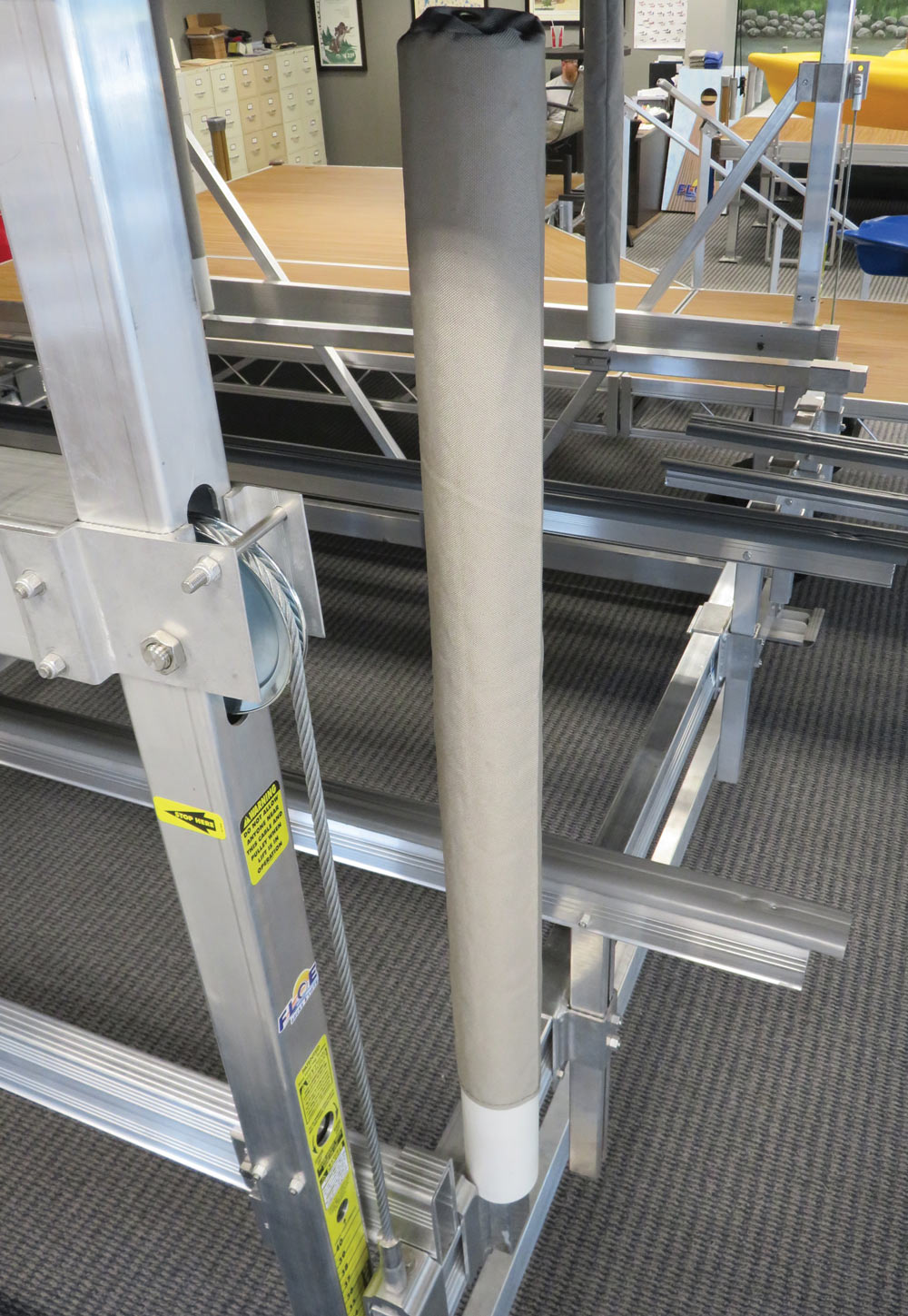
- Most lift manufacturers have, as standard equipment, some type of guide inboard of the lift posts, along the sides of the pontoon logs, to help guide it onto the bunks. Ours are kind of like giant, canvas-covered pool noodles. They compress a little when contacted, but guide the boat in smoothly. Larger, taller, or additional guides are also available to help make it easier and less frustrating to get the boat into the lift.
- Will you be getting on at the bow or stern onto part of the boat that is outside the fence and furniture, or will you enter through a gate along one side or the other of the boat?
- Some lifts accommodate easier access along the sides, but you’ll still need to duck under the canopy frame.
- There are two types of bunks to support a pontoon boat.
- Full-length bunks run most of the length from the bow to the stern of the pontoon. They fit inside the pontoon logs or between the three logs and support the pontoon’s floor structure.
- Cradle bunks, or cradle pads, can be full length or shorter. They support the pontoon logs. They provide more stability to hold the boat in place and require less water depth for the lift. They also act as guides since they form a “V” that holds the bottom of the pontoon log in place. We went with the shorter, cradle bunk system. Our old lift had bare 2- by 6-inch boards that were full length. The new cradles work well to help guide it in and support it in place.
- Our old lift had the familiar 4-foot-or-so-diameter wheel that drove the cable system to lift the pontoon boat. They work well, are less expensive than powered, and, unless horribly abused, will last a long time.
- The old saying about “with age comes wisdom” can be used here, or “with age comes laziness.” Either way, we opted for the power option on our new lift. Simply pushing a button to raise or lower the boat is great. We could also control the power lift through our phone if we had Wi-Fi to the shoreline.
- Power comes from either a 120-volt AC motor or a 12-volt DC motor, which drives a set of gears that drive the cable spool and lift the frame supporting the pontoon boat.
- Since we don’t have 120-volt power to the shoreline, we opted for the 12-volt system but didn’t add the optional solar charging accessory. The automotive-size battery is said to provide more than 100 lifts per season before needing a charge. We’ll see, but that should work for us.
- Power comes from either a 120-volt AC motor or a 12-volt DC motor, which drives a set of gears that drive the cable spool and lift the frame supporting the pontoon boat.
- The old saying about “with age comes wisdom” can be used here, or “with age comes laziness.” Either way, we opted for the power option on our new lift. Simply pushing a button to raise or lower the boat is great. We could also control the power lift through our phone if we had Wi-Fi to the shoreline.
- It keeps the boat dry and free from flying visitors and their droppings.
- The canopy should extend a couple of feet past the bow and stern/engine to help keep the boat out of the sun and rain.
- Make sure to pick the right canopy color and the right size. Our old canopy was very heavy, made of sky-blue vinyl. It weighed a ton and was darn near indestructible. Lifting it from the pier to the canopy frame was a chore for one person. It attached with bungee cords of varying lengths that seemed to change each year I put them on. Each manufacturer has their own attachment system for their canopy, and they’re a lot easier. The material is lighter, very durable, and fade-resistant. When we cruise around the lake, there aren’t that many different colors of covers. Green seemed to be the most popular, followed by black, blue, and red. Our dealer had almost 12 colors to choose from. According to them, the most popular color for the past few years has been black. Second most popular was charcoal gray. We now have a black canopy cover over our boat. While some folks want the canopy cover color to match something on the boat, the only thing ours matches is the engine.
- Our canopy cover came with a nice bag made of the same material, which our lift installer said no human could possibly ever get the cover back into. I guess that’s like folding a fitted bed sheet. He suggested we store the canopy cover in a plastic tote to save it from becoming dinner for small, furry critters. Good idea.
We like our new lift and thoroughly enjoy the power lift feature. We trust it will serve us well for many years to come and keep our pontooning fun and enjoyable.
www.floeintl.com
www.lakesidedocks.com