

By Roy Sparks

Know BEFORE YOU Tow custom stylized digital typographic title
What do you really need to pull your boat?
When you’re seriously considering buying your first pontoon or deck boat, there are so many questions you should ask yourself. However, some of the most important yet commonly overlooked questions you should address are, “Where will I be using it most?” and “How heavy is this vessel and can my current vehicle pull it?” Some owners might have their own dock with a boat lift, in which they may never need to tow their boats onshore except for winterization and to return it at the start of the next season. In a lot of cases, though, recreational boaters tend to tow and haul their vessels regularly to and from a lake or river.
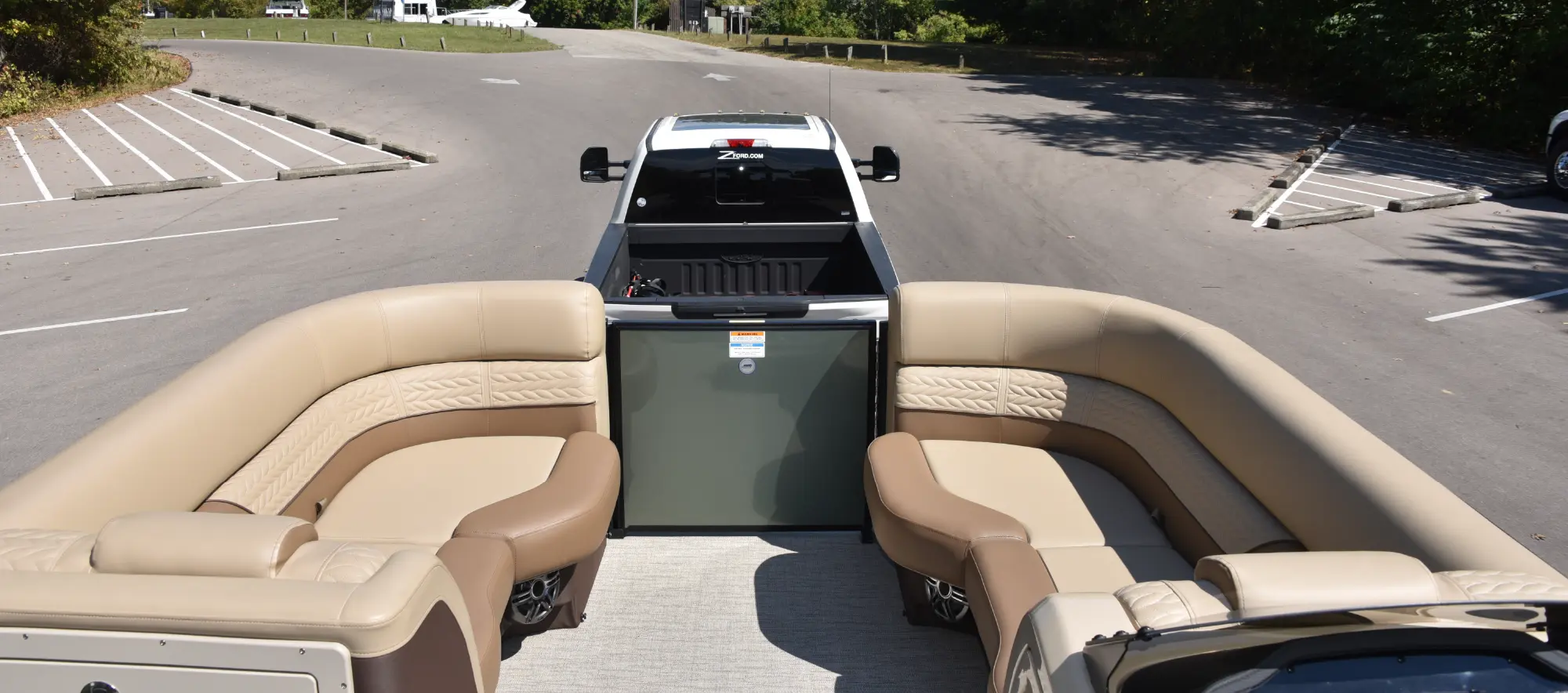
A view from the back of a pontoon motorboat, showing its light brown or tan beige colored cushioned seating; In the center of the boat, there is a small doorway path gate entrance; A white pickup truck is visible ahead, attached to the boat's trailer; The truck is backed into a boat launch parking lot, with trees and a few other vehicles in the background
Getting Ready To Tow
In getting your vessel to and from the body of water, you’ll need a vehicle that can handle the load well, and it may be easy to understand why not just any road machine with a hitch is up for the job. The vehicle best suited also depends on the weight of your vessel, as pontoons and deck boats come in varying shapes and sizes. Your vehicle may already be well-suited for towing the boat, or it may not. If you’re not sure, you can look at the gross combination weight rating (GCWR) on the manufacturer’s sticker in the driver doorsill or your vehicle owner’s manual. For this application, that number means the maximum safe weight limit of the tow vehicle, boat, trailer, and each unit’s occupants and cargo combined.

If you need concrete numbers to help you understand, the average dry weight of a pontoon boat is around 2,200 to 2,500 pounds. You then add the trailer (average weight is about 1,000 pounds), and the outboard engine(s) add on another 200 to 600 pounds depending on their size. Factor in the other weighing variables as well, such as fuel, watersports gear, fishing equipment, and other cargo (let’s say that all adds up to 200 pounds at a given moment). Of course, these numbers are just estimates to help get you started; actual amounts will vary.
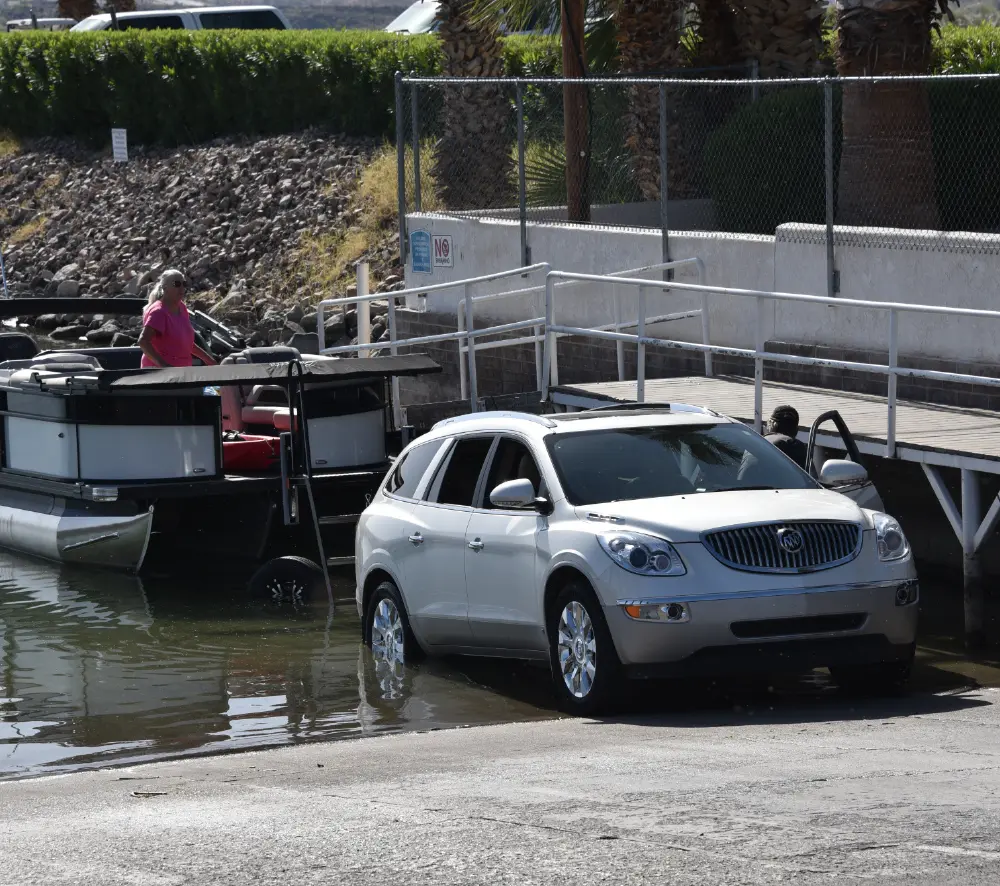
A white SUV is backed into a lake on a concrete boat ramp, preparing to launch a dark grey, black, and chrome colored pontoon motorboat; A woman in a pink shirt is on the boat and another person is visible by the driver's car side door of the white SUV; A dock and chain link fence are in the background, with the shoreline visible on the left
Law & Safety First
Although manufacturers set their numbers as an extreme precautionary measure and there may be some wiggle room in there, you should by all means not exceed the GCWR. You know you don’t want to risk burning up your transmission, wearing out other engine or power train components prematurely, voiding your vehicle’s warranty (if it’s still under it), getting fined for an unsafe load, or, most importantly, getting into an accident. Note that most sedans are not as well-suited for towing boats as are crossovers, SUVs and pickup trucks. With that said, let me explain the best vehicle types for regularly towing a pontoon or deck boat. If you’re in the market for a new vehicle, it’s probably not a bad idea to look for one with a tow package, which includes mechanical components such as a transmission cooler in addition to a hitch platform and wiring harness. Believe me, that option makes a hauling vehicle so much better outfitted for the boating lifestyle. Also look into a four-wheel drive (4WD) or all-wheel-drive (AWD) powertrain, because that’ll help you with traction on the boat ramp.
Crossovers
You don’t necessarily need a full-size SUV or pickup truck to haul a pontoon or deck boat, but for bare-minimum vehicle class and size in regular towing and hauling, you should go no smaller than a three-row midsize crossover SUV. By that, I mean vehicles such as the Ford Explorer, Chevy Traverse, Honda Pilot, Toyota Highlander, or Nissan Pathfinder. With a 4WD-or-AWD powertrain, recent model years of these crossovers have towing capacities ranging between 5,000 and 6,000 pounds. They make excellent family vehicles because of their spacious interiors with lots of seating, and they’re also great for long road trips and recreational adventures. Generally speaking, they’ll also please you with fuel economy.
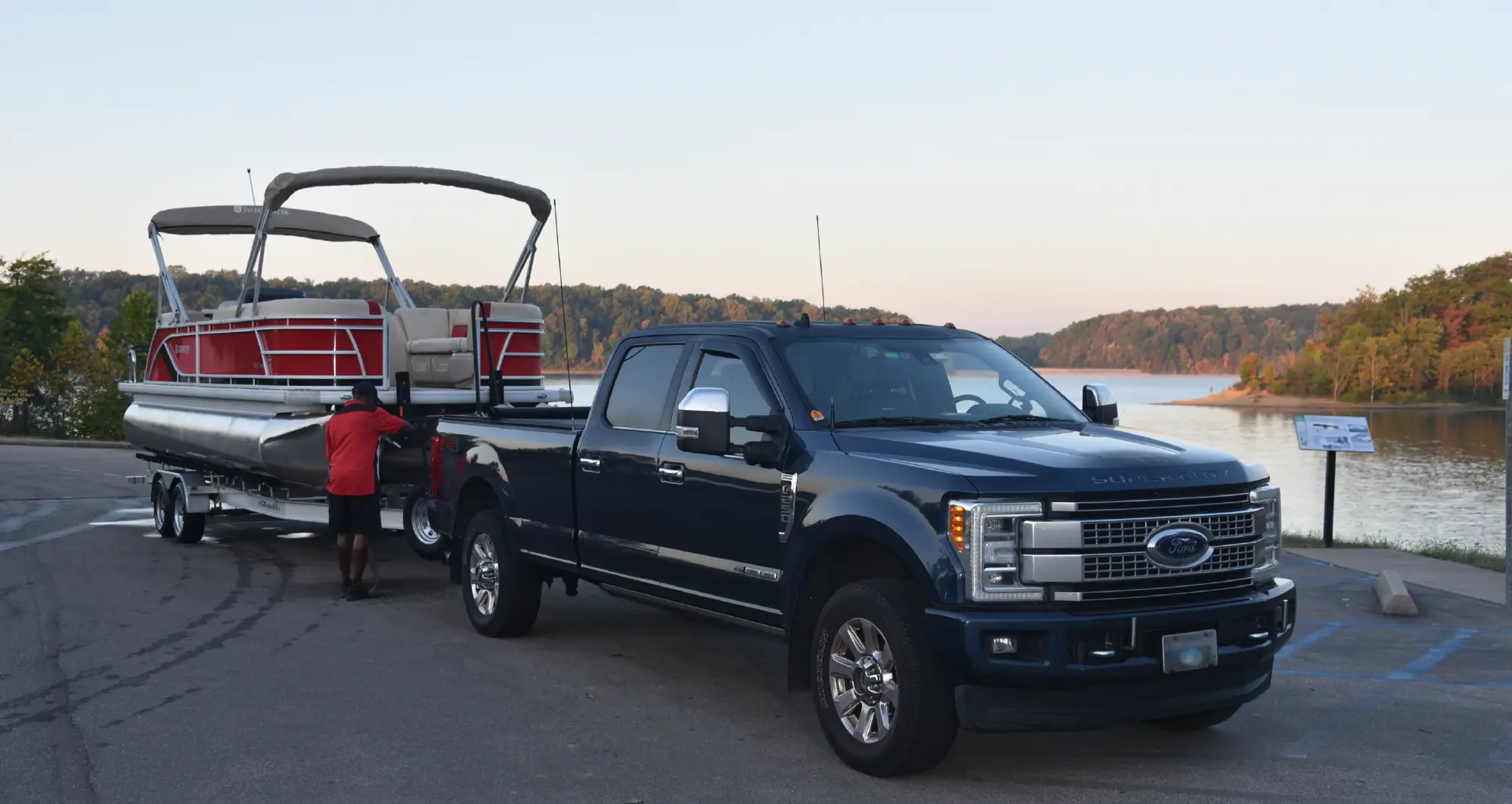
A dark navy blue Ford Super Duty pickup truck is backed up to a boat launch ramp, with a red/beige colored pontoon motorboat on a trailer attached to it; A person in a red polo top shirt is standing near the back of the boat; The boat is facing a lake surrounded by trees under a bright, early evening sky
Weight also adds up quickly from everything you put in and on your boat. Fuel economy will suffer when you reach the towing capacity. However, that may not matter much to you, depending on how often and how far you’ll haul your boat. If you’re looking for a great family vehicle with the best fuel economy that can also tow a good amount when you need it to, a midsize crossover with 4WD-or-AWD is your best bet.
SUVs
If you’re ambitious for a vehicle with a large interior that’ll put you virtually in the clear for boat towing, then by all means go with a larger truck-based SUV. Vehicles such as the Ford Expedition, Chevy Tahoe/GMC Yukon, Toyota Sequoia, and Nissan Armada all have towing capacities ranging between 6,000 and 8,500 pounds for the most recent model years. With the upper end of this range, you’ll have no issues towing the largest `toons, such as the high-end luxury models with dry weights around 4,500 pounds in some cases.

Because these capacities are so high, it’s easier to get away without 4WD when towing and launching with these vehicles, but it’s always nice to have. You should keep in mind these vehicles are known to drink some fuel, but that probably won’t matter to you if you spend a lot of time towing and hauling the heavy stuff. On top of that, these SUVs are more spacious and just as well-built for long road trips and family adventure as their midsize crossover counterparts.

Trucks
Pickup trucks are constrained for interior space compared to crossovers and SUVs, but there’s no denying they’re the best built tow vehicles for anything overall. Midsize and half-ton pickups are the best suited for towing recreational boats; half-tons are very much preferred for many larger pontoons. Pontoons because of their height on the trailer can also produce strong wind resistance when traveling on the highway, making them seem heavier than they are. Having a truck gives you a strong advantage here. You could choose a larger pickup than a half-ton if you want, but they’re way more than enough for what you’ll be doing. Especially as many of the smaller pickups now come with high-torque diesel engine options just like their big brothers, they make for an amazing towing and hauling choice. Even a pickup as small as the Chevy Colorado/GMC Canyon has a towing capacity of 7,700 pounds for the 2025 model year with the standard 2.7-liter TurboMax engine. Half-ton pickups such as the Ford F150 and RAM 1500 have diesel options that offer well above 10,000 pounds of capacity. Even though some of the gas V8 engine options provide more towing capacity, if you choose a diesel option, you’ll get more output for the fuel you use; chances are you’ll also flat-out save yourself mileage over the gas engine options.

If you have a smaller vessel and want a truck to pull it but don’t want all that unnecessary haughtiness, then consider something such as the Honda Ridgeline, which has a 5,000-pound capacity with the AWD powertrain. If you want more interior space in a truck, you can always opt for a crew cab where applicable. Your family will love you for doing it, especially if you’re regularly traveling long-distance.

It’s Your Turn
It’s a lot to take in, but if you’re in the market for a tow vehicle, hopefully this gives you some useful information on the best road machines out there for handling the weight of a sizable recreational boat on a trailer. While it’s not possible to give you all the pointers you may need, I can certainly tell you the overarching ones. When you’re boat hunting, you can see there’s a lot more to pay attention to than the specified dry weight of your prospective vessel, which is just the boat with an empty fuel tank and nothing on or in it, and not even an engine in most cases. If you already have a vehicle that you believe fits the bill for towing and would like to use it, and if you know someone who owns a pontoon or deck boat, maybe you could ask to test the load on your vehicle by driving it to the scale and comparing the real-time gross combined weight (GCW) to your GCWR. If the measured GCW on the scale display is higher, then your load is too big. In fact, I would try to leave at least 1,000 to 2,000 pounds of leeway between the two numbers on full fuel tanks in both the boat and tow vehicle, as you’ll need to add in the weight of the passengers and cargo. Your local boat dealer should be able to help you out with this as well, so please take advantage of them.